3 Things International Students Must Know About Japan
1. Working in Japan Is More Realistic Than You Think — The Real State of Foreign Hiring
Still believe Japan is hard for foreigners to work in?
As of 2024, the number of foreigners working in Japan hit a record high of 2.57 million. (Source: Ministry of Health, Labour and Welfare, January 2025) Professional visa holders alone (Engineer/Specialist in Humanities/International Services) exceeded 418,000, growing at double digits every year. (Source: Immigration Services Agency of Japan, 2024 Statistics on Foreign Residents) With structural labor shortages driven by a declining birthrate and aging population, Japanese companies are actively seeking foreign talent.
Let's get more specific. According to government data, the top industry among companies hoping to hire foreigners is IT/Software (22%), followed by Electronics/Electrical (17%), Trading/Wholesale (17%), and Professional Services (16%). (Source: JETRO Foreign Talent Recruitment Database)
Here's where many people get it wrong: you don't need a large company to find a great opportunity. According to JASSO's career path survey, roughly half of international students who find employment in Japan join companies with fewer than 100 employees, and about 80% join companies with fewer than 1,000 employees. (Source: JASSO Job Hunting Guide for International Students 2027) Many Japanese SMEs hold world-leading positions in niche fields — company size alone is not a reliable guide to opportunity.
That said, there's a reality you need to face. The number one quality companies seek in international students is communication skills, and number two is Japanese language ability — ranked above technical expertise in both arts and sciences fields. (Source: JASSO survey, December 2024) Approximately 70% of companies require at least business-intermediate Japanese at the time of a job offer, rising to approximately 90% after joining. Requirements vary by company and hiring cycle — always confirm directly before applying.
On the flip side, the number of positions where English alone is sufficient is growing — especially in IT, R&D, and engineering. If you have a STEM background, targeting English-OK companies alongside Japanese study is a viable strategy. That said, even at English-OK companies, Japanese is often needed in day-to-day work — always verify the actual working environment before accepting an offer.
The barrier to working in Japan is language — not your nationality. If you have JLPT N2 or above and a STEM background, there's every reason to start preparing now.
2. The Fast Track to Permanent Residency in Japan — Everything About the Highly Skilled Professional (HSP) Points System
In the US, Indian nationals wait an average of over 10 years for a green card. Canada's Express Entry typically takes 2–4 years. Japan has a system where you can apply for permanent residency just one year after starting work — one of the fastest pathways among major developed countries. That's the Highly Skilled Professional (高度専門職) points system.
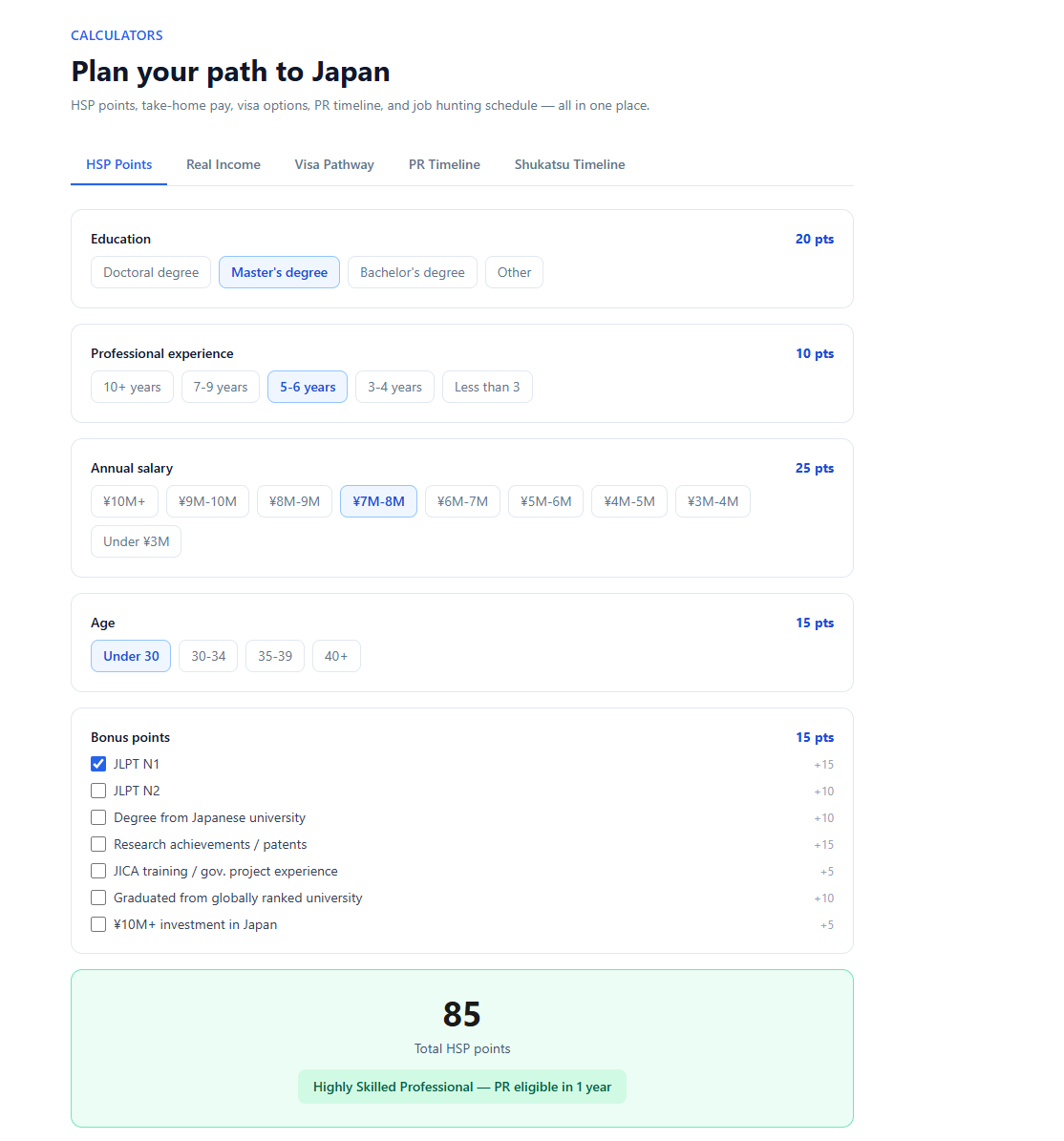
The system assigns points across categories — academic background, work experience, salary, age, and Japanese ability — and applicants who score 70 points or above qualify for the HSP visa. (Source: Ministry of Justice Permanent Residency Guidelines, revised October 30, 2025) Points criteria are set by ministerial ordinance and subject to change — always check the latest official standards before applying.
70 points or above: eligible to apply for PR after 3 years
80 points or above: eligible to apply for PR after 1 year
Here's what that looks like in practice. Master's degree (20 pts) + JLPT N1 (15 pts) + Japanese graduate school (10 pts) + ¥5M annual salary (15 pts) + age 30–34 (10 pts) = 70 points → 3-year PR path. A PhD (30 pts) + ¥6M salary (20 pts) + age 29 or under (15 pts) = 90 points → PR eligible in 1 year
As of 2024, there are 28,708 active HSP visa holders — 92 times the 313 recorded when the system launched in 2012. (Source: Immigration Services Agency of Japan, 2024 Statistics on Foreign Residents) The cumulative number of approvals since launch stands at 55,688. The gap between cumulative approvals and current holders suggests a substantial number have already converted to permanent residency, though this figure also includes those who have left Japan and cannot be confirmed precisely.
A few important caveats. Scoring 70+ points does not automatically grant PR. You must complete the required residency period and have consistently met public obligations — taxes, pension, and health insurance — on time. Even after obtaining PR, leaving Japan for more than one year without a re-entry permit can result in losing your status.
You can calculate your HSP points right now. Plugging in your degree, salary, and age to see how close you are to 70 — and which categories to improve — is the first step in building a Japan PR strategy.
You can calculate your HSP points:
www.visionspector.com/jp/calculators
3. The Myth That Tokyo Is the Best — A City-by-City Comparison
When people think about studying or working in Japan, Tokyo is almost always the first city that comes to mind. And yes, it has the most job opportunities and the highest concentration of global companies. But cost of living varies significantly by city, and Tokyo is the most expensive.
Here's how average monthly rent for a single person compares across major cities. (Source: National Rental Housing Business Association, 2025. Figures reflect market-rate rentals and vary significantly between city centers and suburban areas — check current local listings before making decisions.)
City Average Monthly Rent (1-room) vs. Tokyo
Tokyo ¥72,000 —
Osaka ¥58,000 −19%
Nagoya ¥52,000 −28%
Fukuoka ¥48,000 −33%
Sapporo ¥41,000 ~ 45,000 −38 ~ 43%
One important note on Sapporo: while rent is among the lowest, winter heating costs are substantially higher than in other cities - utility bills can run ¥20,000~30,000 more per month during winter, which significantly narrows the apparent cost advantage.
For international students specifically, JASSO's FY2023 survey puts average monthly housing costs — including dormitories and shared housing - at ¥57,000 in the Tokyo area versus ¥29,000 in the Kyushu region (Fukuoka and surrounding areas), a difference of nearly ¥28,000 per month. (Source: JASSO Student Life Survey, FY2023)
Here's how each city positions itself for career purposes:
Tokyo: The largest concentration of job opportunities across IT, finance, consulting, and trading. Highest competition and highest cost of living among major Japanese cities.
Osaka: Strong base in manufacturing and trade. An established international resident community. Fewer absolute foreign-hire openings than Tokyo, but meaningfully lower housing costs.
Nagoya: Dominant in automotive and manufacturing, with Toyota headquarters in the surrounding region. Relatively high Japanese language requirements and a smaller international community compared to Tokyo or Osaka.
Fukuoka: Startup-friendly with strong connections to the rest of Asia. Lower cost of living than Tokyo or Osaka. Smaller absolute job market than the top three cities.
Sapporo: Cool summers and a scenic natural environment. Low rent on paper, but factor in heating costs before treating it as the cheapest overall option.
Tokyo offers the most opportunities, but Osaka, Nagoya, and Fukuoka offer meaningfully lower living costs with viable career options. Choosing a city based on your field, Japanese level, and financial situation matters more than defaulting to the most well-known name.
Tokyo offers the most opportunities, but Osaka, Nagoya, and Fukuoka offer meaningfully lower living costs with viable career options. Choosing a city based on your field, Japanese level, and financial situation matters more than defaulting to the most well-known name.